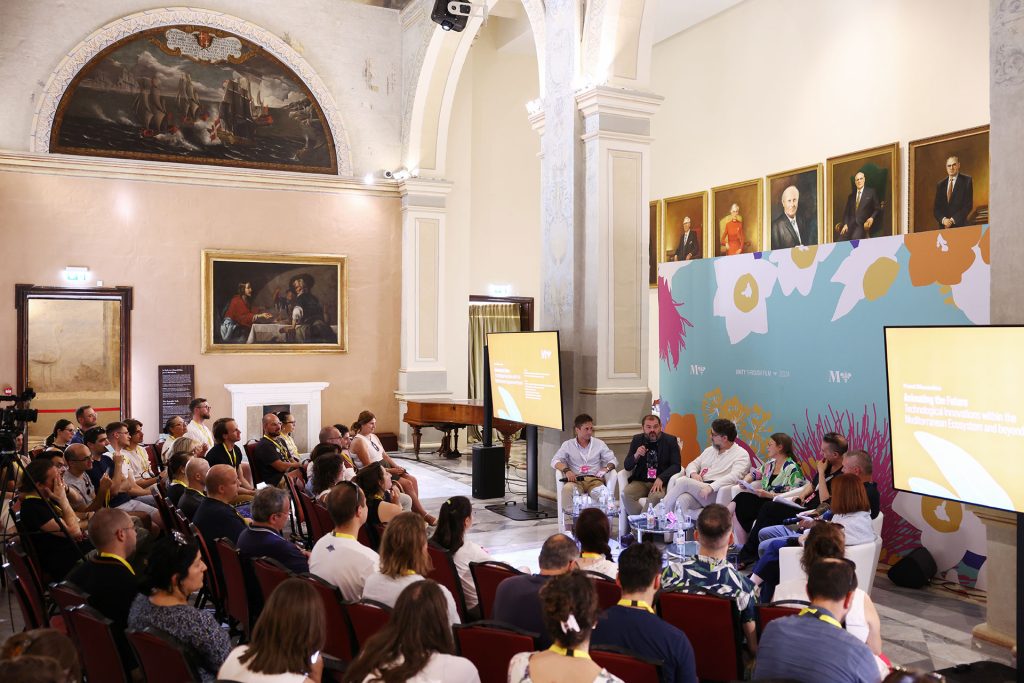
Paul Arion, Founder and CEO of Control Chaos Ltd., Film Maker, Director, Script Writer and Cinematographer; Jean Pierre Debattista, COO at Toontuloon Animation Studio; Tim Miller, Film Director and Producer; Andrea Milore, President of Mikros Animation; Matthew Pullicine, CEO at Stargate Studios Malta and Alexander Savitskiy, Co-Founder of Cineloop VFX took part in a lively panel today titled ‘Animating the Future’, moderated by Dr Paula Callus, Principal Academic at National Centre for Computer Animation, Faculty of Media and Communication at Bournemouth University.
The panellists sat down this afternoon to explore the future of animation, analysing the opportunities and risks that come along with new technologies and how the field has changed in recent years. They discussed the importance of hiring a strong collaborative team, and how someone’s character as a manager and being a team player is imperative in a successful project – sometimes more so than technical expertise.
Panellists also noted the shorthand that close knit teams start to develop and how this synergy elevates whatever they work on together, as well as how new team members can bring different ideas from working with other practitioners on previous projects.
The panel of industry experts discussed the heavily debated topic of AI and the ethical complexities it could hold. In recent months, the topic of ownership and rights within the film community has been a topic of contention with YouTube being used as resource to train AI and the slippery slope this can create in leveraging artists’ work to train tools which can replace them – to infringing on using someone’s voice or likeness without permission.
They also discussed the opportunity it could bring, with animation being an incredibly expensive and labour-intensive process traditionally, AI could lend filmmakers the chance to tell bigger stories that they may not necessarily have been able to afford to make before. The speakers also discussed how despite it being an intimidating new arm of technology, you still need a creative eye to know what looks good – so AI can be used as a tool to instead ignite multiple choices.
They also discussed how these developments can work to democratise technology. Not only will it be beneficial to the speed of production and the amount of projects that can be made, but it could also give the chance for individuals to be part of the industry where it wouldn’t be possible previously, making up for skill deficits – for example a creative person who can’t draw. It also allows the opportunity for remote working to be possible – and how when the pandemic hit, the animation and SFX community had to quickly adapt, creating a new ecosystem and breaking down limitations of collaborating with creatives internationally.